What Is GERT Suit Training and Why Is Experiencing Frailty So Important?
Most people working in health and social care understand that ageing can affect strength, mobility, hearing, vision, balance and dexterity.
They know an older person may need more time. They understand the importance of preserving independence. They have probably heard the words dignity, choice and person-centred care many times during their training.
But knowing something and truly understanding how it feels are not always the same thing.
That is why we use the GERT Age Simulation Suit at Essential 6.
It gives learners an opportunity to experience some of the physical and sensory restrictions that can be associated with ageing and frailty. It turns familiar everyday activities into something much more challenging and helps people consider their own professional practice from the perspective of the person receiving their care or support.
For us, this is not about putting on a suit for a few minutes and creating an entertaining training activity.
It is about helping people stop, think and understand.
It is about turning knowledge into greater empathy and awareness.
Most importantly, it is about helping learners recognise how their communication, environment and behaviour can either support a person's independence or unintentionally take it away.
What is the GERT Age Simulation Suit?
The GERT suit is specialist simulation equipment that can reproduce several physical and sensory restrictions associated with ageing.
Different components can be used to simulate:
- Reduced joint mobility and stiffness
- Restricted movement of the head and upper body
- Reduced strength
- Changes to balance and coordination
- Reduced grip and dexterity
- Changes to vision
- High-frequency hearing loss
- Increased effort when walking or completing everyday tasks
The components are designed to work together because challenges are rarely experienced in isolation.
Someone may be trying to stand from a chair while also experiencing reduced strength, restricted movement, poor grip, impaired vision and difficulty hearing instructions.
A task that appears straightforward to somebody providing support can feel entirely different to the person being asked to complete it.
The GERT experience helps learners explore this in a controlled, supported and professionally facilitated environment. The suit's documented simulations include joint stiffness, reduced strength and grip, coordination restrictions, changes to vision and high-frequency hearing loss.

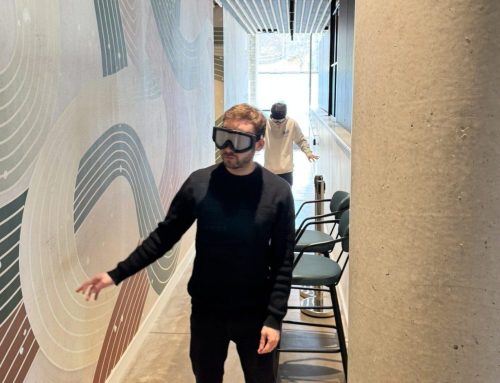
Learner completing Essential 6 GERT suit ageing and frailty-awareness training
Is frailty simply part of getting older?
No, and this is an important point within our training.
Frailty is more common as people grow older, but it is not an inevitable consequence of age. Older people are not one single group, and we should never assume somebody's abilities, needs or level of independence based purely on their age.
The British Geriatrics Society describes frailty as a clinical state involving reduced physiological reserve and increased vulnerability to adverse outcomes. This means that an illness, injury or other stressor that might have a limited effect on one person could have a much greater impact on someone living with frailty.
The GERT suit does not show learners exactly what it feels like to be an older person, because there is no single experience of ageing.
It also cannot reproduce somebody's medical history, pain, emotions, confidence, personal circumstances or lived experience.
What it can do is allow learners to experience selected restrictions and then consider how those restrictions affect everyday activities, communication, confidence and independence.
That distinction matters to us.
Our purpose is not to portray older people as weak, incapable or dependent. It is to help staff become more thoughtful about how they communicate, how they offer support and how quickly they may step in and take over.
Why do we believe immersive frailty training is so important?
We can explain reduced mobility on a presentation.
We can tell learners that hearing loss may affect communication.
We can discuss the importance of allowing someone sufficient time.
We can teach staff to promote choice, dignity and independence.
All of that is important, but it can still remain theoretical.
The GERT suit gives learners an experience they can connect those principles to.
When familiar movements become slower and more difficult, learners begin to understand why someone may hesitate before standing.
When instructions become harder to hear, they recognise how confusing it can be when several people speak at once or when a member of staff talks while facing away.
When vision, grip and coordination are restricted, they see why opening packaging, fastening clothing or picking up an object may require more concentration and effort than expected.
When another person intervenes too quickly, learners begin to understand the difference between supporting someone and simply completing the task for them.
That is where the learning becomes personal.
It is no longer just a statement on a slide. The learner has felt the frustration, effort or uncertainty for themselves.
What do learners actually do during the experience?
The activities we use depend on the learners, their roles and the purpose of the training.
We do not believe in using the suit as a standard demonstration that is delivered in exactly the same way to every group. The experience should connect to the work people actually do and the individuals they support.
Learners may be asked to complete seemingly simple activities such as:
- Standing from a chair
- Walking across a room
- Navigating around objects
- Picking up and handling small items
- Opening packaging
- Reading information
- Pouring a drink
- Putting on an item of clothing
- Following spoken instructions
- Completing a familiar workplace activity
These tasks are not designed to catch anyone out.
They are used to create discussion.
The most important part of the experience is often not whether the learner completes the activity. It is what they notice while attempting it.
Was the chair too low?
Was the person given enough time?
Were the instructions clear?
Was the room noisy?
Were too many instructions given at once?
Did the helper ask what support was needed?
Did they encourage the person or immediately take over?
Did the environment make the task more difficult than it needed to be?
How did it feel when somebody became impatient?
These are the conversations that help translate the experience into better professional practice.
What do our trainers see during GERT suit training?
Our trainers regularly see an immediate change in how learners approach what initially appears to be a simple activity.
People often begin confidently. They expect to be able to stand, walk, reach, listen or handle an object in the same way they usually would.
Once the restrictions are introduced, they slow down.
They become more cautious.
They may need to concentrate on movements that would normally require very little thought.
Some become frustrated. Others lose confidence or become reluctant to continue without reassurance.
This creates some very honest discussions.
Learners begin to recognise how easily a person can be labelled as uncooperative, slow or unwilling when the real issue may be that the task, environment or communication is creating a barrier.
They also see how the behaviour of the person supporting them affects the experience.
A calm explanation can provide reassurance.
Being given sufficient time can preserve confidence.
One clear instruction can be more helpful than several instructions delivered quickly.
Asking before intervening can protect choice and control.
By contrast, being rushed, spoken over or physically guided without a clear explanation can make somebody feel uncertain and powerless.
These may appear to be small details, but they can completely change how a person experiences care and support.
What do learners tell us afterwards?
Learners regularly tell us that the GERT experience is one of the most memorable and thought provoking parts of their training.
Many say they understood the principles before wearing the suit but had not fully appreciated how much effort an everyday task could require.
They tell us the experience helps them empathise more deeply with people who are living with physical or sensory restrictions.
They also tell us that it makes them question habits they may not previously have noticed, such as:
- Giving instructions too quickly
- Approaching someone from behind
- Completing a task for somebody because it appears faster
- Assuming hesitation means refusal
- Moving someone before explaining what is happening
- Focusing on completing a task rather than involving the person
- Underestimating the physical and mental effort involved
One of the most valuable outcomes is that learners continue talking about the experience afterwards.
They remember how it felt.
They relate the activities to people they support.
They discuss what they could do differently.
That is important because memorable training is more likely to be recalled when someone returns to practice and faces a similar situation.
Does GERT suit training improve empathy?
Age simulation research has produced encouraging findings, particularly around awareness, understanding and specific aspects of empathy.
Studies have reported that simulation suits can help learners better understand the challenges some older people experience and can improve particular dimensions of clinical empathy. Research involving nursing and dental students has also found improvements in awareness or empathy following age simulation activities.
However, we believe it is important to be honest about the evidence.
Not every study has found a statistically significant increase in general empathy scores. Research also warns that age simulation must be facilitated carefully so it does not unintentionally reinforce negative stereotypes about ageing.
This supports what we already believe through our own training practice:
The suit alone is not the training.
Simply asking somebody to wear it does not automatically create empathy, change behaviour or improve professional practice.
The learning comes from the combination of:
- A carefully planned experience
- Relevant and realistic activities
- Skilled facilitation
- Accurate information about ageing and frailty
- Structured reflection
- Discussion with other learners
- A clear connection to professional practice
The equipment creates the opportunity.
The trainer helps turn that opportunity into meaningful learning.
Can the experience influence professional behaviour?
This is ultimately why we use it.
We do not want learners to leave simply saying that the suit was interesting or enjoyable.
We want them to consider what they will do differently.
The experience can encourage staff to:
Give people more time
A person may need time to process an instruction, reposition themselves, find their balance or prepare physically before moving.
Hesitation does not necessarily mean that someone is unable or unwilling.
Communicate more effectively
Learners experience why it is important to gain the person's attention, face them, reduce unnecessary background noise and provide clear instructions at a manageable pace.
They also recognise that speaking louder is not always the answer to hearing loss.
Ask rather than assume
A person should be asked what support they need rather than having somebody automatically decide for them.
This helps protect choice, dignity and control.
Support independence
Helping someone does not always mean doing something for them.
Appropriate support may involve changing the environment, allowing more time, breaking the task into manageable stages or offering reassurance.
Notice environmental barriers
Poor lighting, cluttered walkways, low seating, background noise, unclear signage and difficult packaging can all increase the challenge faced by someone with physical or sensory restrictions.
Sometimes the difficulty is not located solely within the person. It is created or increased by the environment around them.
Recognise fatigue and concentration
When movement and communication require greater effort, an ordinary task can become physically and mentally tiring.
This can affect how staff plan activities, appointments, rehabilitation, personal care and other interactions.
Protect dignity
Being rushed, ignored, spoken over or physically moved without explanation can feel deeply disempowering.
The experience encourages learners to think not only about whether a task is completed safely, but also about how the person feels while it is happening.
Is there a danger that simulation training could reinforce stereotypes?
Yes, if it is delivered without sufficient care or context.
We would never introduce the GERT suit by saying, "This is what it feels like to be old."
It is not.
Many older people remain active, independent and physically capable. People of the same age can have entirely different strengths, experiences, health conditions and support needs.
It would be inaccurate and disrespectful to suggest otherwise.
Instead, we explain that the suit represents selected physical and sensory restrictions that some people may experience.
We then ask learners to consider:
- What barriers did you encounter?
- Which barriers came from the restriction?
- Which were created by the environment?
- What did another person do that helped?
- What made you feel rushed or less confident?
- How could support have been offered differently?
- What could you apply in your own workplace?
This prevents the session from becoming an exercise in portraying ageing negatively.
The purpose is to challenge assumptions, not reinforce them.
Who can benefit from immersive ageing and frailty-awareness training?
We often associate frailty awareness with care homes, but its relevance is much wider.
The training can benefit people working in:
- Hospitals and NHS services
- Community healthcare
- Adult social care
- Domiciliary care
- Care and nursing homes
- Primary care
- Integrated neighbourhood teams
- Rehabilitation services
- Occupational therapy
- Physiotherapy
- Case management
- Housing and supported living
- Local authorities
- Charities and voluntary organisations
- Emergency services
- Transport
- Hospitality
- Customer-facing services
- Service design and management
It can be valuable for nurses, healthcare assistants, care workers, support workers, therapists, case managers, social workers, managers, educators and anyone whose decisions or actions affect older people.
The experience is also useful for people who may not regard themselves as providing care.
A receptionist, housing officer, transport employee, hotel worker or customer-service team can still influence whether a service feels accessible, patient and respectful.
How do we use the GERT suit in other Essential 6 courses?
The GERT suit can be delivered as part of a dedicated ageing and frailty-awareness experience, but we also use it to strengthen learning in other areas.
People moving and handling
The suit helps learners consider how reduced strength, restricted mobility, confidence and communication can affect transfers and movement.
It reinforces the importance of preparation, consent, positioning, reassurance and allowing the person to participate as fully as possible.
Falls awareness and prevention
Learners can explore how vision, balance, obstacles, seating and confidence may interact.
This encourages staff to consider the person, the activity and the environment rather than simply advising somebody to "be careful."
Dementia awareness
The GERT suit does not simulate dementia, and we would never claim that it does.
However, selected physical and sensory restrictions can help learners consider how communication difficulties and environmental barriers may increase distress or uncertainty for someone who is also living with dementia.
Fire safety and evacuation
The experience can help staff understand how restricted mobility, reduced hearing or impaired vision may affect a person's response during a fire or evacuation.
It creates valuable discussion around emergency communication, personal emergency evacuation plans, escape routes, evacuation equipment and the time someone may need to respond safely.
First aid
Learners can consider how frailty, reduced mobility, sensory impairment and communication needs may affect assessment and treatment.
It can also support discussion around reassurance, consent, positioning, falls and skin fragility.
Customer service and accessibility
Organisations can use the experience to review how accessible their services, buildings and processes are for older people and others living with physical or sensory restrictions.
What should organisations expect from good GERT suit training?
The value of the training does not come from owning the equipment.
It comes from how the equipment is used.
A good immersive ageing and frailty-awareness session should:
- Explain the difference between ageing and frailty
- Avoid generalising about older people
- Use activities that are relevant to the learners
- Provide a safe and supported practical experience
- Encourage honest reflection
- Connect the experience to workplace behaviour
- Promote dignity, choice and independence
- Challenge environmental and organisational barriers
- Give learners practical actions they can apply afterwards
A provider should not simply put learners into the suit, ask them to walk around and then move on to the next person.
There must be a purpose behind each activity and a discussion about what happened.
The question is not only, "What did the suit make difficult?"
It is also, "What could we change to make the experience safer, more respectful and more person-centred?"
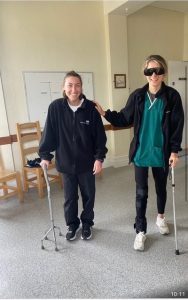
Gert suit training. Learners experiencing the Gert suit simulation.
Why does Essential 6 use immersive training?
At Essential 6, we have always believed that training should be practical, engaging and relevant.
People need accurate knowledge, but they also need opportunities to apply it, question their assumptions and understand how their behaviour affects others.
The GERT suit supports that approach perfectly.
It helps learners experience why patience matters.
It demonstrates why clear communication matters.
It shows how easily independence can be reduced when somebody steps in too quickly.
It encourages learners to look at the environment rather than always seeing the person as the problem.
Most importantly, it helps make the learning memorable.
Our trainers use the experience to create meaningful conversations, not to provide entertainment or produce a dramatic reaction.
We want learners to return to work thinking differently.
We want them to pause before taking over.
We want them to ask what support a person wants.
We want them to explain what is happening, allow enough time and recognise the effort someone may be making.
That is when training begins to shape professional practice.
Is GERT suit training worth investing in?
It can be extremely valuable when it is properly facilitated and connected to the learner's role.
The GERT suit is not a replacement for listening to older people, understanding their individual needs or providing evidence based care.
It is a learning tool that helps staff reflect on how physical and sensory restrictions may affect everyday life.
Used well, it can help learners:
- Develop greater empathy and understanding
- Question unconscious assumptions
- Communicate more effectively
- Recognise environmental barriers
- Preserve choice and independence
- Avoid rushing or taking over
- Appreciate the effort involved in everyday activities
- Connect policies and values to real behaviour
- Remember and apply their learning in practice
No simulation can allow us to know exactly what another person is experiencing.
But it can make us stop assuming that we do.
For many learners, that realisation is the point at which knowledge becomes understanding and understanding begins to change behaviour.
Bring the GERT Age Simulation Experience to your organisation
Essential 6 provides practical and immersive ageing and frailty-awareness training for healthcare, social care, rehabilitation, case management, local authority, voluntary sector and customer facing teams.
The GERT Age Simulation Experience can be delivered as a focused training session or incorporated into relevant courses, including people moving and handling, dementia awareness, falls prevention, first aid and fire evacuation training.
We can adapt the experience around your workforce, working environment and the people your organisation supports.
Because staff should not only know that a person may need more time, clearer communication or a different approach.
They should understand why it matters.
Speak to the Essential 6 team about bringing immersive ageing and frailty-awareness training to your workplace or incorporating the GERT experience into your wider staff-development programme.
Call 01803 26 66 66 or email info@essential6.co.uk for further information.